AI workloads have changed what many data centers need to support. Training models or running inference often means servers that pull more power and generate more heat than traditional applications.
A single high-end GPU server can easily consume several kilowatts. When you put several of them in one rack, the density jumps quickly. Traditional air-cooled designs that worked fine for 5–10 kW per rack start to struggle.
What high-density actually means
High-density usually refers to racks that can safely support 20 kW, 30 kW, or even higher. That requires stronger power distribution, better cooling, and careful airflow or liquid cooling.
Without the right design, you either cannot fill the rack fully or you end up with hot spots that force servers to throttle. Either way, you lose efficiency and capacity.
Facilities that already plan for higher power density tend to make running AI workloads more straightforward. You do not have to spread servers across many more racks just to stay within limits.
Cooling becomes the real constraint
Power is one side. Cooling is often the harder part. Hot air from dense racks needs somewhere to go, and traditional raised-floor or perimeter cooling can run out of capacity fast.
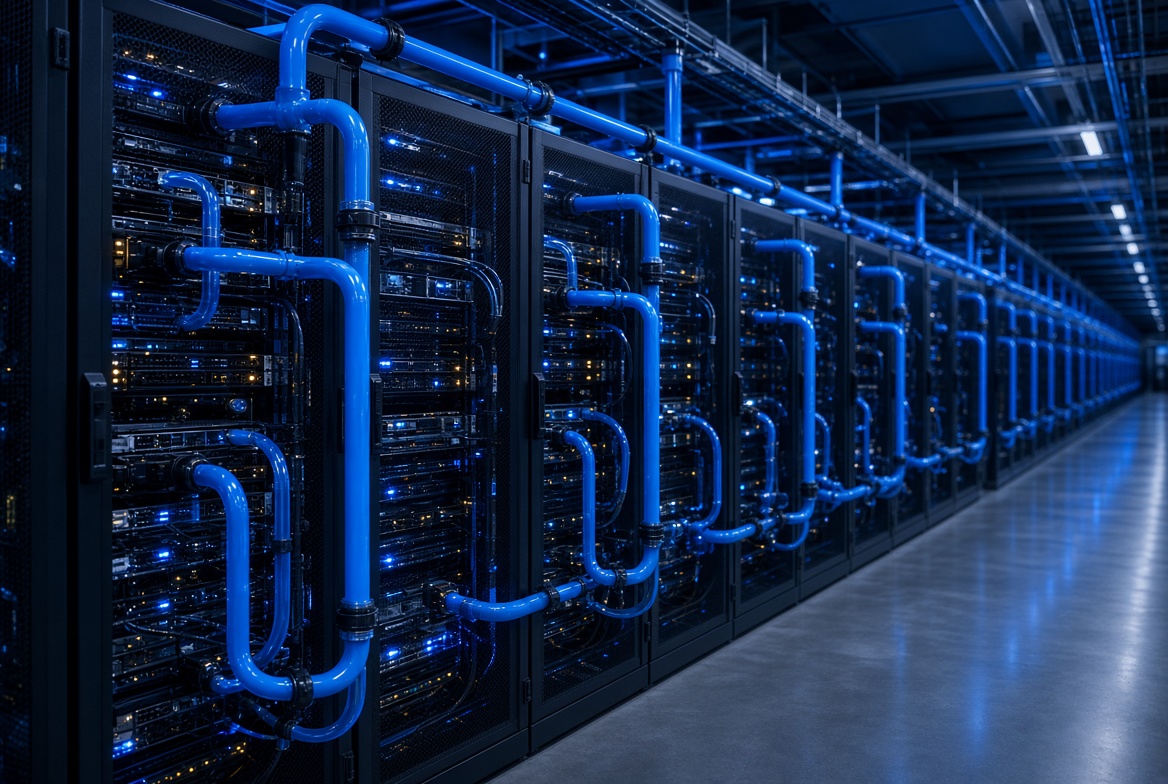
Many newer or upgraded halls use containment, in-row cooling, or rear-door heat exchangers. Some are moving toward liquid cooling for the highest densities.
If the data center was designed with these options in mind, adding AI capacity later is usually smoother. Facilities close to major internet exchanges in Jakarta also tend to make stable connectivity easier to maintain while you scale compute.
Space and cost implications
Higher density means fewer racks for the same compute power. That can save floor space, which matters when colocation costs are calculated per rack or per square meter.
It also reduces the amount of cabling and switching you need between racks. Latency inside the cluster can stay lower because everything is closer together.
The trade-off is that each rack becomes more critical. A problem in one high-density rack affects more compute. That is why redundancy in power and cooling at the rack level becomes more important.
Practical steps before you place AI servers
Check the maximum power and cooling available per rack at the facility you are considering. Ask for the actual delivered capacity, not just the nameplate number.
Look at whether the site already supports liquid cooling or has clear plans for it. Also confirm the network connectivity options, especially if your AI cluster needs high-bandwidth links to storage or to other sites.
Many teams prefer colocation that also offers a disaster-recovery option in a different city so regional risks stay manageable. When workloads start moving toward AI or need higher power density per rack, a data center built for that load is simply more comfortable to run.
ISC facilities that hold Tier IV certification and sit near major internet exchanges tend to make these choices easier because the power, cooling, and connectivity foundations are already strong.
In short, high-density capability is no longer a nice-to-have for AI. It is becoming one of the basic requirements if you want to run modern GPU clusters without constant workarounds.