Many teams still treat data centers as a place to park servers and hope the power and cooling stay out of the way. That approach works for classic office systems and light cloud apps. It starts to strain when the workload shifts to AI training, inference, or high-density GPU clusters.
AI does not just need more megabits. It needs more watts per rack, more predictable cooling, and a facility that can grow without constant rewiring of the power path. If those pieces are missing, the first symptoms are usually heat, throttling, and unexpected capacity limits — not a neat error message in the application.
What changes when racks get denser
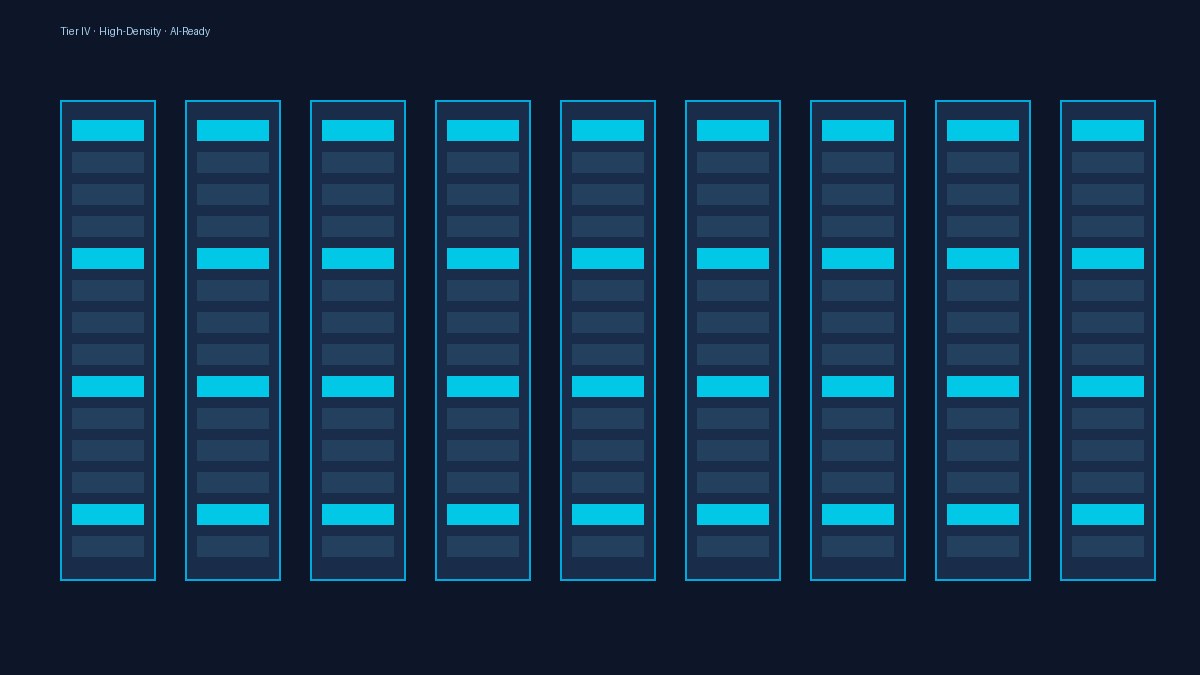
Traditional enterprise racks often sit in a comfortable range of power draw. AI and GPU-heavy setups push that number much higher. A single rack can demand several times the power of a standard business rack, and the heat follows the same curve.
That means the facility must support higher power density without forcing every customer into a special room. Cooling has to keep up — air alone is often not enough once density climbs. Liquid or hybrid approaches become practical, not experimental.
Connectivity also matters more than people expect. Moving large model checkpoints or streaming inference results across a congested path adds delay and cost. Being close to major internet exchanges and having clean cross-connect options reduces that friction.
Why “good enough” cooling stops being good enough
When racks stay cool under normal load but tip into thermal limits during peak training jobs, performance drops and hardware life shortens. Operators then face a choice: throttle the workload, spread it across more racks, or move to a facility designed for higher density from the start.
Facilities that already plan for higher power and cooling per rack tend to absorb growth more calmly. Teams spend less time negotiating emergency capacity and more time running the actual models.
Location and redundancy still count
Even the best power and cooling design needs a stable site. Being near major internet exchanges in Jakarta helps keep latency low for regional users and for links between sites. A disaster-recovery option in a different city — for example in Bali — gives another layer of protection when regional risks appear.
Soft selling fits naturally here: facilities that already hold Tier IV certification and sit close to major internet exchanges in Jakarta tend to make stable, high-density operation easier to maintain. When workloads move toward AI or need higher power density per rack, a data center built for that load is simply more comfortable to run. Many teams also prefer colocation that offers a disaster-recovery option in a different city so regional risks stay manageable.
Practical questions before you place AI gear
Before committing racks for GPU or AI workloads, a short checklist helps:
- What is the real power available per rack, not just the brochure number?
- How is cooling designed for sustained high density, not only average load?
- Can the facility add capacity without major redesign of the power path?
- How close is the site to the internet exchanges your traffic actually uses?
- Is there a clear path for disaster recovery in a separate location?
Clear answers to these questions usually prevent the common surprise of “we ran out of power before we ran out of floor space.”
A calmer way to grow into AI
AI does not require every company to build its own hyperscale campus. For many teams, the practical path is colocation in a facility that already supports higher density, reliable power, and strong connectivity — then grow step by step as the models and the business need it.
The facilities that feel easiest to operate are the ones that treated power, cooling, and location as first-class design choices, not afterthoughts. When those pieces are in place, the conversation shifts from “will the room hold the next rack?” to “what should we train next?”