When your business starts using AI or data-heavy applications, the servers sitting in the office often struggle quickly. It is not just slow performance. The machines get hot, power becomes limited, or they suddenly shut down. Many people immediately think “maybe the application is too heavy”. Quite often the real issue is the place where those servers live.
A good data center is not only about racks and air conditioning. What matters is how ready it is to handle high loads stably, without making you worry every night. This is where Tier IV starts coming up in conversations, especially for AI workloads that are power-hungry and cannot afford interruptions.
Why AI workloads are different from ordinary servers
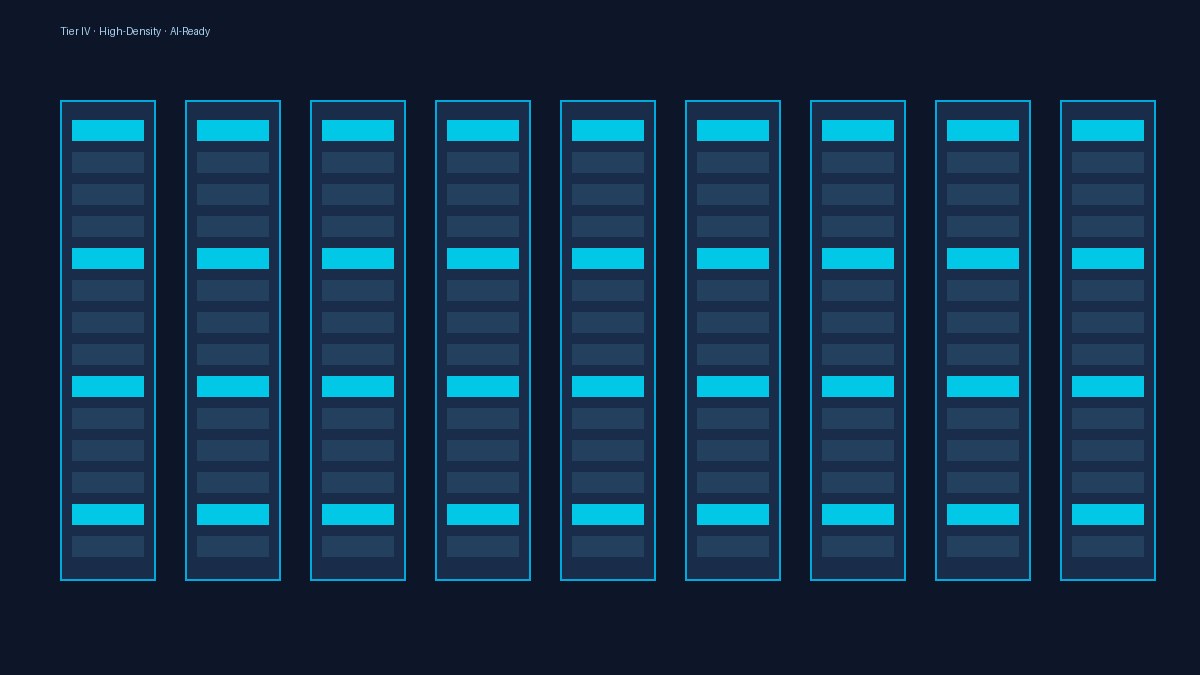
A regular server running websites or email usually needs around 5–10 kW per rack. Modern AI servers can demand 20 kW or even higher per rack. That means cooling has to be much stronger, power has to stay stable, and backup power must be ready at all times.
If cooling is insufficient, temperature rises. When temperature rises, servers throttle or shut down. For AI that is training a model or serving real-time inference, even a short downtime can mean wasted money and time.
That is why more companies are looking for data centers designed for high density. Not just “there is AC and UPS”, but systems that have been tested to carry continuous heavy load.
What Tier IV actually means
Tier IV is the highest standard from the Uptime Institute. In simple terms: every critical system (power, cooling, network) has fully separated dual paths. If one path fails, the other takes over immediately without disruption.
Compare that with Tier III. Tier III is already good — you can do maintenance without turning services off. Tier IV goes further: it is fault-tolerant. Even when something breaks suddenly, the system keeps running.
The typical Tier IV SLA is 99.995 percent. In a year, the “allowed” downtime is only about 26 minutes. For businesses that rely on AI or real-time transactions, that number matters a lot.
Facilities that already hold Tier IV certification and sit close to major internet exchanges in Jakarta tend to make stable connectivity easier to maintain. That is one reason many companies start looking at colocation in places like that, especially when their workloads begin shifting toward AI.
Location and connectivity also matter
It is not only about the internal reliability of the data center. Location counts too. The closer you are to an internet exchange (IIX or IX), the lower the latency to other providers. Local traffic does not have to travel overseas first.
For AI applications that frequently exchange data between servers or between locations, low latency can save both time and bandwidth cost. Cross-connects are also easier and cheaper when the providers are already inside the same data center.
So when choosing a place, do not only look for “Tier IV” on the brochure. Also ask how close it is to the main internet exchanges, how many providers are already present, and whether there is a disaster-recovery option in another city.
Practical tips before deciding on colocation
If you are considering moving servers to a data center, here are a few things worth checking first:
- Does the facility already have clear Tier certification (not just a claim)?
- What is the maximum power capacity available per rack?
- How does the cooling system work (air-cooled, liquid cooling, or hybrid)?
- Is there remote hands / smart hands support outside office hours?
- Is there a disaster-recovery option in a different location (for example Bali) so regional risks can be reduced?
Many teams prefer colocation that also offers a disaster-recovery option in a different city so regional risks stay manageable. It is a simple step that is often overlooked.
When your workloads start moving toward AI or need higher power density per rack, a data center built for that load is simply more comfortable to run. You do not have to keep worrying about power and cooling every day.
Short takeaway
AI workloads are changing how we look at data centers. What used to be “good enough” can now feel insufficient. Tier IV, high density, strategic location, and a disaster-recovery option are becoming the combination more people look for.
You do not have to move everything at once. Start with the most critical workloads. Watch the performance, compare the cost, then decide the next step. The important thing is not to let infrastructure become the bottleneck of business growth.